The first salary a person receives will forever be memorable. It most certainly would be quite small in most cases, but nevertheless, the fact that you earned something of your very own, working for someone outside of your family, and after days of tiring effort, does mean a lot.
The Very First Salary
Soon after completing school and living off a rupee or so of pocket money a day, I wanted to earn something of my own. I applied for the position of a Trainee Sales Assistant at the Titus Stores. They asked me what I want to do after the results of my Advanced Level examination will become known, and if I planned to enter University. At the time, I only wanted to become a Pilot, but knew my parents did not have the money, and didn’t want me to join the Airforce either.
So, just after about a month of leaving school, I earned my first salary of Rs 1,773.35 for the month of October 1993. I had to learn a bit about classical music and be in charge of the Naxos CD sales at the Liberty Plaza outlet. A memorable character was uncle Bandusena who was in charge of security. He alerted me whenever suspected shoplifters were nearby. I never lost a single CD, but one day a shoplifter stole the calculator I was given. Although my mother gave me lunch from home every day, I hated the crowded bus ride home at night on the Galle Road.
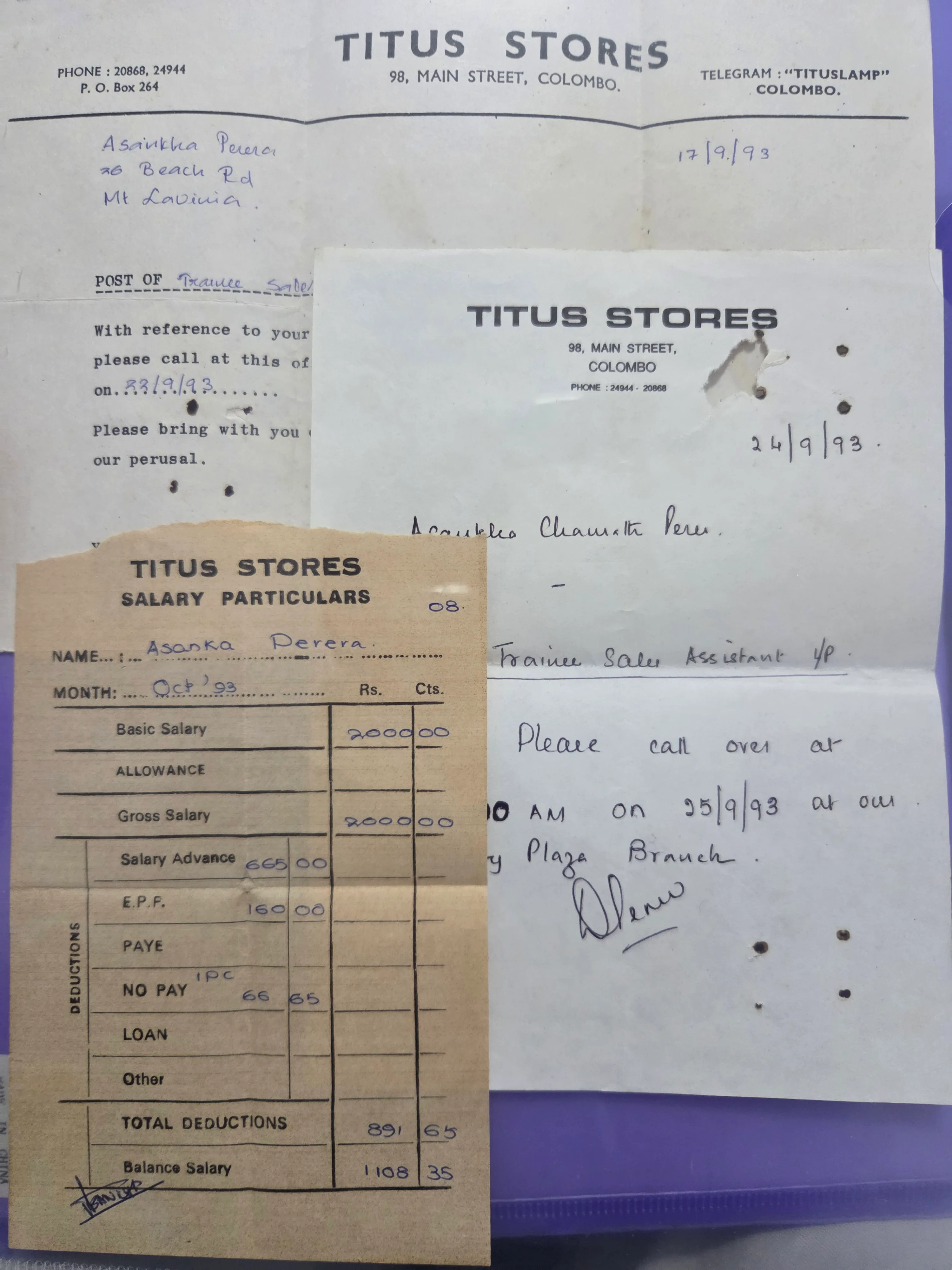 First Salary Slip - October 1993
First Salary in IT
After I completed my Diploma in Computer Systems Design at the National Institute of Business Management (NIBM) in 1994, I received my first salary related to Information Technology.
My first employer was none other than International Business Machines or IBM. I was a contractor to IBM Sri Lanka, helping with pre-sales and support activities for IBM Visual Gen and OS/2.
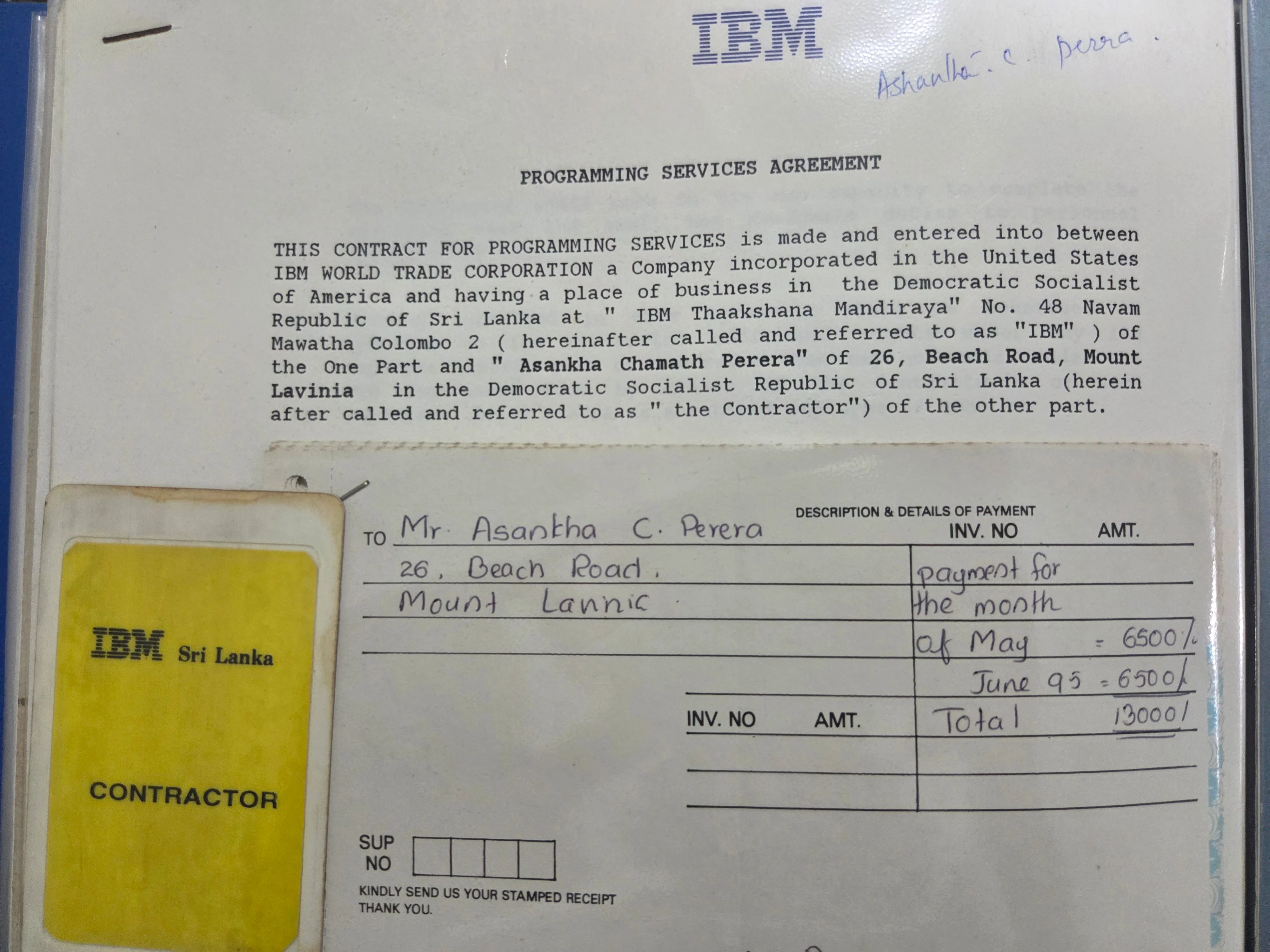 Contractor at IBM Sri Lanka
The salary was Rs 6,500 per month, but the highlight was that transport was provided when you worked late - in a chauffeur driven taxi called “GNTC” at the time. So, after working late many nights, I would just sit and fall asleep in the comfortable air-conditioned taxi on my way home. IBM required me to wear a long-sleeved shirt and a tie every single day, which was quite cool and I guess I looked smart. Unfortunately, I do not have a single photograph of these days since cameras were still using film reels and were scarce. I worked at IBM till January 1996, at which time I left to enter the University of Colombo.
First Part-Time Salary
During the first two years of my degree at the University of Colombo, I studied Computer Science & Statistics, Applied Mathematics and Physics. I found out that if I did well in Computer Science alone, I could qualify to specialize in Computer Science with the 4 years honors degree. So, starting from April 1996, I joined the NIBM as a Programmer Analyst with a salary of Rs 2,600/-. Due to lectures, most of my salary would be lost to no-pay, but I did earn a bit by working during the weekends and during ’night practical’ sessions where students would stay the whole night over to complete their programming assignments on the IBM AS/400 or S/360 Mainframe, Wang VS minicomputer, or the Novell Netware LAN of PCs.
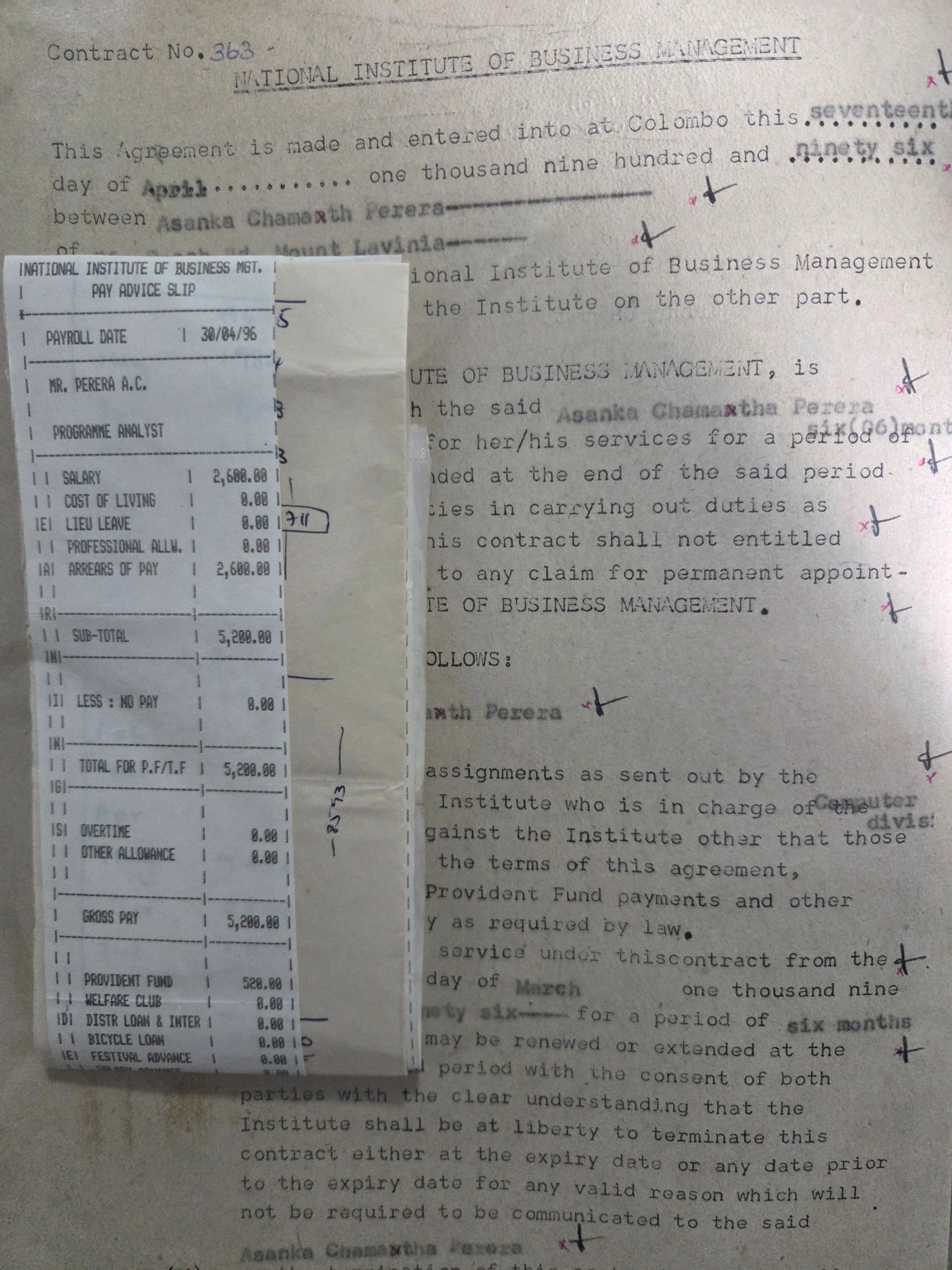 Employment during the first two years at University
First Salary After Graduation
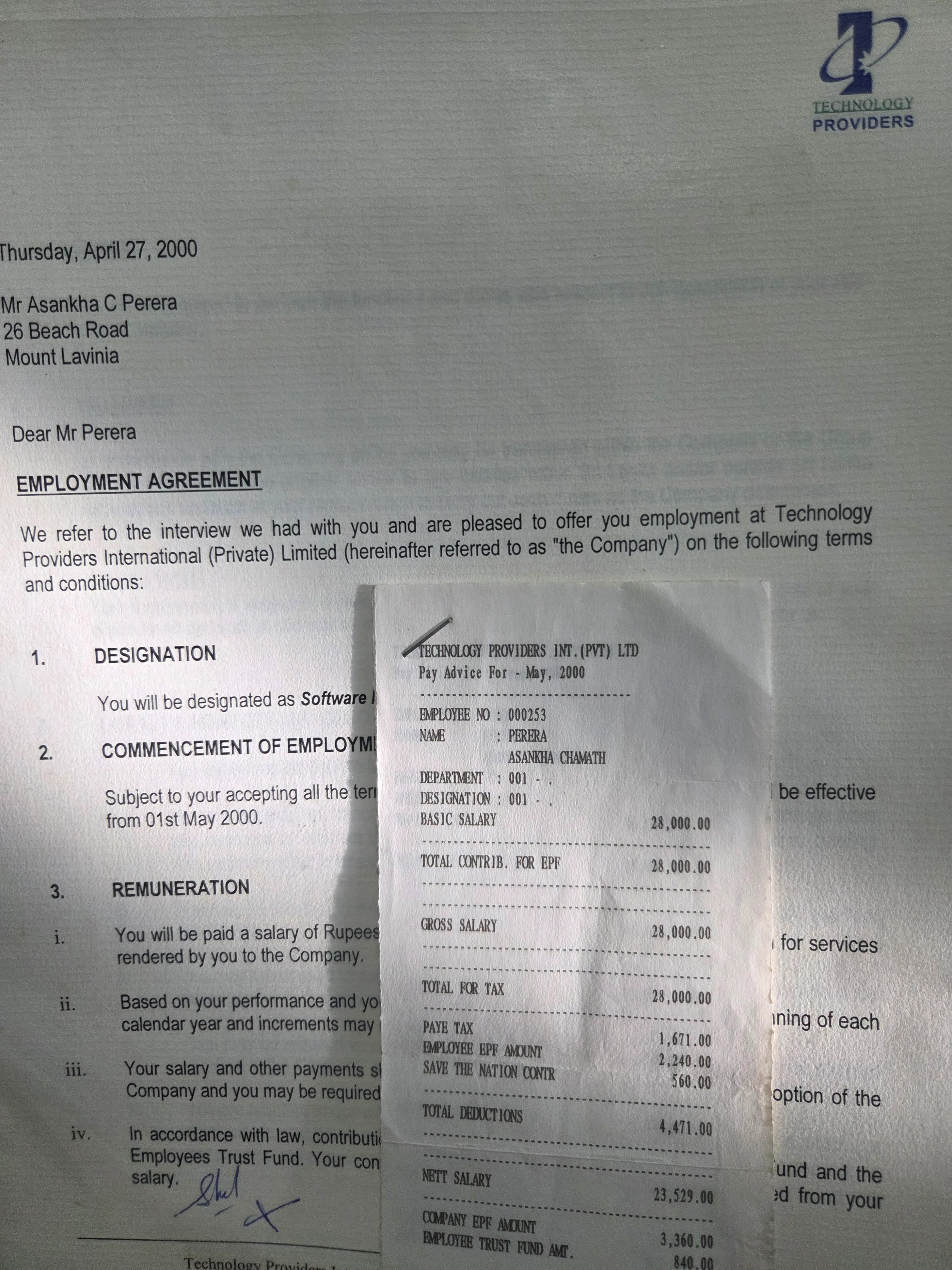
As I completed my degree at the University of Colombo, I was hired by Virtusa, known as Technology Providers at the time with a salary of Rs 28,000/-. I joined from May 2000 and was employee no 253. I was offered Rs 3,000 more than my peers, as I ranked first from my batch of 26 students who specialized in Computer Science.
At first, I could not believe why I was paid so much. But the first opportunity for me came when the MarketWorkz project - where I joined as the most junior engineer - encountered an error parsing an XML file. The team was trying to find the cause, and I asked for a copy of this source file and ran it through different parsers myself and found the culprit to be an invalid character within the file. After this, my manager Chamindra De Silva asked me to try out a Java profiler called ‘JProbe’. This opened up a whole world of opportunity for me to learn about writing high performance code. By June 2001 the client eDocs made me lead the project as a co-architect with Thushara Wimalasena. This gave me the opportunity to work directly with the future CTO of Virtusa, Shahani Markus - even before she officially joined Virtusa. I had to work with her to migrate the code to run on a JEE server called WebLogic and later, Shahani wrote a letter of recommendation for me to do my master’s later on at the National University of Singapore.